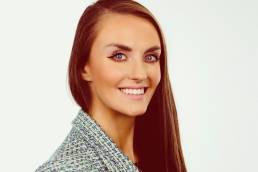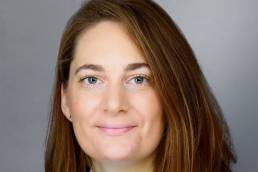

Belgium-born Inge Delobelle is CEO of thyssenkrupp Access Solutions, one of the leading suppliers of mobility solutions in homes and airports.
Prior to this, she was the company’s CFO and has been at thyssenkrupp for over 15 years serving in a series of financial and management roles in Germany and France.
Inge is leading the Access Solutions business through an important time as it develops innovative and future-thinking technology solutions to support mobility in cities across the world. Under her leadership, and building on thyssenkrupp’s partnership with Microsoft, Access Solutions is revolutionizing home mobility solutions to make their implementation faster, easier and more helpful for customers.
Using the HoloLens mixed-reality devices, engineers can now easily scan a staircase and measure each step in real-time, leading to quicker design, manufacturing and installation. Innovations like these are helping to ensure that people can remain within their homes for longer regardless of any age or disability impediments, whilst maintaining their quality of life.
In airports, Access Solutions is also delivering several passenger boarding bridge and gate solutions that will help improve turnaround times for operators while enhancing safety and passenger comfort.
In both airports and homes, thyssenkrupp Access Solutions excels at providing highly customized products that are tailored to individual customer needs.
Tell us a bit about yourself, background and your current role
I am Belgian by birth but have worked in France and Germany for all my professional life. My professional experience has been quite varied – ranging from investment banking to the steel industry and now to urban mobility. I am currently CEO of thyssenkrupp Access Solutions, one of the leading suppliers of mobility solutions in homes and airports worldwide. Before I took this role I was the CFO and, in total, I have been at thyssenkrupp for over 15 years.
Right now, my role involves leading Access Solutions through an ever changing technological and social landscape. As populations grow, we’re having to think more and more about urban and personal mobility, and I’m striving to ensure that we excel at providing highly customized products that are tailored to individual needs, both in airports and in our homes.
Did you ever sit down and plan your career?
I think I am more of a generalist. The only thing I knew for certain was that I wanted to start working in Germany as it is the most important economic power in Europe, and then to take on a more global role from thereon. My approach to my career was more about asset collection – what new skills or knowledge could I gain, and where could I add most value? I am not afraid of responsibility, in fact I thrive on it, so when I found a role that offered me the opportunity to learn something new and really build my skill set, I took it!
Have you faced any challenges along the way? How did you deal with them?
Challenges are a part of everyday business life and can vary from economic contexts to industry drivers and cultural differences. If you work on a global level, you quickly find that one approach that fits a certain regional market will certainly be different from another, and cultural differences of people from diverse backgrounds add to this complexity.
In this rapidly evolving world, for me what is crucial to deal with these challenges is to try and always be one step ahead – always be well prepared and consider alternative scenarios. I also strongly believe in the strength of diverse teams, and that is why they are key in my leadership approach.
Do you have a typical workday? How do you start your day and how does it end?
For me, there is no such thing as a typical workday. On a high level, I am very clear on my objectives for the year, which I break down and plan on a quarterly basis. Each day, prior to following up on strategic projects, coordination of teams and resources, and any unforeseen operational issues, I love to arrive early in the morning and reflect on the priorities ahead. At the end of the day, I like to review whatever I’ve accomplished and also think ahead to the near future.
How do you feel about mentoring? Have you ever had a mentor or do you mentor anyone?
I think mentoring is important and can be hugely beneficial in a professional environment. My mentor was one of my former Partners in the investment banking industry. She was very professional, but always involved with those who reported to her and in control of her operations. She taught me “Everything at the right time and place,” which is advice that I still follow today. She taught me to really analyse every situation and opportunity and adapt accordingly, which has proved to be an invaluable skill.
As for me, I have in the past and continue to mentor several employees within the thyssenkrupp organization – not always in a formal structure but certainly whenever they need advice and guidance.
How do you think we can encourage more women and girls into a career in STEM?
By making it okay to explore avenues that are not traditionally seen as “women-friendly”. Initiatives like Women Who Code are a great example. I think we should also tell girls that they don’t have to wait for someone to tell them what is okay to do – that it is fine to venture into the grey spaces bravely!
If you could change one thing for women in the workplace, what would it be?
Honestly, I haven’t ever felt the differentiation of being a woman in the workplace. My experience of triggering interest and openness in a company to the richness of diversity is being, above all, authentic in being different, i.e. not trying to imitate male colleagues and behaviour. In addition, it’s also important to be aware of the consequences or your targets and what it will take to achieve them. I think everyone has to be very honest with themselves about what is possible and what is not, regardless of their gender. If you want to work part time, that’s fine, but you will probably not make it to CEO. If you want to work full time and make it to the top, that’s okay too, but you will probably not make it to your children’s school Christmas parties. Both are choices, and you have to be clear that there are always consequences for every choice.
What has been your biggest achievement to date?
Overall, I would consider my greatest achievement has been to build high-performing teams with the right people and the right mind-set. Motivating people to take their own path and jump into the grey spaces of their lives and seeing them achieve their goals gives me a wonderful payback. On the professional front, I am really proud of leading thyssenkrupp Access Solutions to achieve a five-fold increase in its EBIT margin!
What are you hoping to achieve in the future?
The goal there is quite simple: to make thyssenkrupp’s home and airport solutions as well-known as possible. On the home solutions side, I would like to contribute to making the ageing process less of a stigma than it is today, and for airports, I want to see solutions like passenger boarding bridges as less of a “product” and more of an asset for delivering exemplary customer value. On both fronts, I see digital innovations as a game changer and thyssenkrupp Access Solutions is going to continue to using new technologies to make it easier to navigate increasingly challenging urban landscapes. We will be making some exciting announcements very soon, but you’ll have to stay tuned to hear about those!